
Customer Story: Colocating a Rack That Feels Like Part of the Office
An anonymised Fast2Host colocation story — why a UK team moved a rack into Cambridge, how remote hands changed break/fix, and what “extension of our office” looks like in practice.
Most colo brochures talk about U-count and amps. Customers talk about something else: whether the facility behaves like their own plant room — or like a black box with a ticket queue.
This deep-dive is built around a real Trustpilot review from a Fast2Host colocation customer, expanded with how we typically design rack + remote hands for UK teams who already own their hardware. Names and internal metrics stay anonymised; the quote is theirs.
“We colocate a rack with Fast2host — remote hands are genuinely useful and the facility team know our kit. Feels like an extension of our office, not a faceless DC.”
— Trustpilot reviewer, colocation customer (November 2025)
If you are comparing public cloud vs colocation, or sizing a first rack footprint, this is what “good colo” feels like after go-live.
The starting point
Typical profile for this kind of customer (composite of colo patterns we see weekly):
- They already own servers, firewalls or storage — buying equivalent capacity as cloud VMs would be expensive and wrong-shaped
- Workloads are steady (databases, internal platforms, edge appliances) rather than bursty experiments
- Someone on the team can SSH and manage OS — they do not need a fully managed private cloud
- They still need physical work: reseat a NIC, swap a disk, check PDU lights, escort a vendor, photograph a faceplate
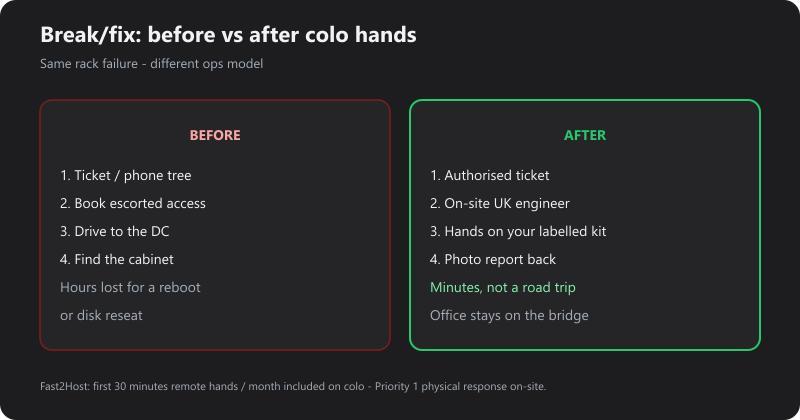
Without colo, those physical tasks mean a drive to a third-party DC, waiting for escorted access, or hoping a distant “smart hands” desk knows which cage is yours.
Why Cambridge colo, not another rented region
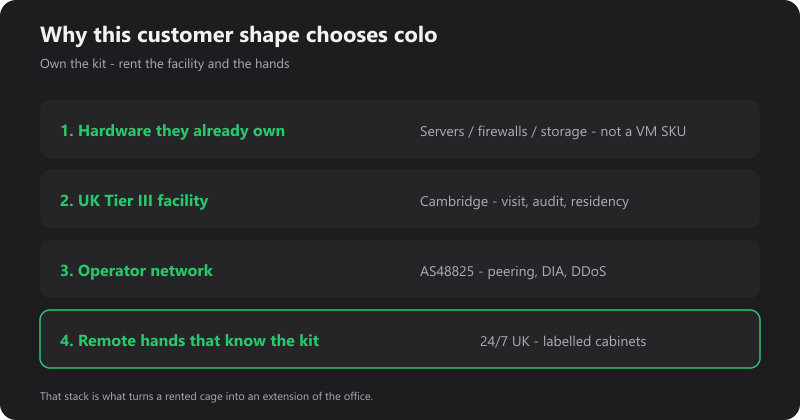
They chose colocation in our Tier III Cambridge facility because:
- UK residency and walk-in accountability — auditors and directors can visit; see why Cambridge matters
- Network they can operate on — AS48825, peering, optional BGP / IP services, always-on DDoS
- Power billed clearly — amps, not mystery envelopes (why we charge in amps)
- Room to grow — start at 1U–5U or jump to quarter, half or full rack without a cloud re-architecture
The unlock: remote hands that know the kit
Hardware in a good DC is only half the product. The review calls out remote hands specifically — and “the facility team know our kit.”
That is deliberate. On Fast2Host colo we:
- Keep labelled, documented cabinet layouts and customer contact lists
- Run UK engineers on-site 24/7/365 — not an offshore relay
- Include first 30 minutes per month free on remote hands, with Priority 1 response targets (see remote hands)
- Send photo reports and an audit trail so the customer’s office team can see what was done
Common tickets that used to mean a site visit:
| Task | Without local hands | With Cambridge remote hands |
|---|---|---|
| Hard reboot / PDU cycle | Drive or wait for escort | Minutes from authorised ticket |
| Disk / transceiver swap | Schedule visit + parts logistics | Engineer on the floor with your parts |
| “Is the link light amber?” | Guess over phone | Photo + confirmation |
| Vendor install (firewall, tape) | Escort day coordination | We escort; you stay on bridge |
| Labelling / patch tidy | DIY next time you visit | Done to your diagram |
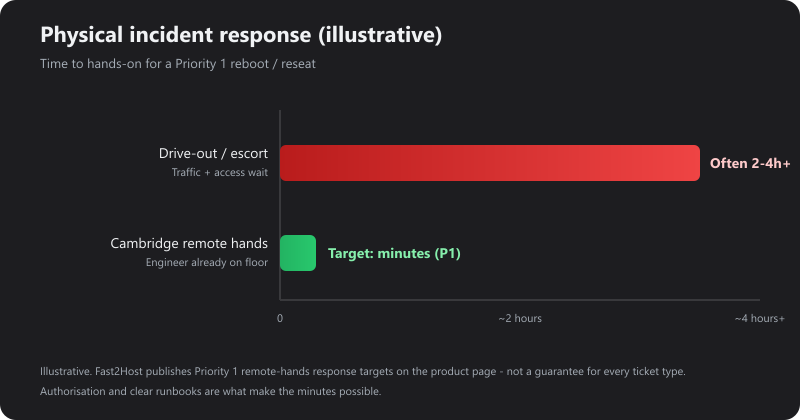
Illustrative response shape — Priority 1 physical work is measured in minutes on-site, not hours on the A14.
What “extension of our office” means in practice
Customers who use that phrase usually have three habits in place:
- Named technical contacts — only authorised people can request hands or access (remote hands policy)
- A simple runbook — reboot order, disk slots, switch uplinks — so the engineer is not inventing your architecture at 2am
- Hybrid connectivity where needed — office DIA or point-to-point into the rack so the colo LAN feels local; optional public cloud connect for AWS/Azure/GCP without abandoning the rack
The facility stops being “somewhere kit lives” and becomes another floor of the building — with better power, cooling and peering than most offices will ever have.
Results they care about (qualitative)
We do not invent ROI percentages for anonymised stories. What this customer segment consistently reports:
- Fewer emergency drives to the DC for trivial physical tasks
- Faster mean time to recover when the failure is in the room, not in software
- Confidence to leave specialised hardware in colo instead of forcing it into a cloud SKU
- A relationship — engineers who recognise the cabinet, not a rotating contractor badge
That matches the Trustpilot line: useful hands, known kit, not a faceless DC.
Is this you?
Colo + remote hands is a strong fit if you:
- Own (or will own) servers / appliances and want rackspace, not another VM catalogue
- Need UK physical control for compliance or customer contracts
- Have a team that can manage OS/apps but not sit in a DC
- Want a path from a few U to a private 42U without re-platforming
It is a weaker fit if you need global regions tomorrow, have no hardware ops appetite, or only need a brochure site — start with Cloud VPS or web hosting instead. More context: cloud vs colocation and the buyers guide.
Next step
Tell us your U-count, power draw and whether you need office-to-rack links. We will quote colo + remote hands the way this customer runs it — as an extension of your office.