

What is colocation?
Colocation is the practice of placing your own server hardware in a third-party data centre and paying for rack space, power, cooling and connectivity. You keep full control of the hardware, the operating system and the data; the data centre provides the resilient building around it — diesel generators, UPS, precision cooling, security and carrier-grade network.
Compared with public cloud, UK colocation usually wins on long-run cost for steady workloads, on predictable I/O performance, and on data sovereignty — the kit physically lives in the UK, under your control. Compared with on-premise server rooms, it removes the building risk: no surprise aircon failures, no single-feed power, no broadband outages taking production offline.
Tier III data centre standards explained
The Uptime Institute Tier classification is the most widely cited standard for UK data centres. Tier III requires concurrently maintainable infrastructure — every component (power path, cooling unit, switchgear) can be taken offline for maintenance without dropping live IT load.
- Tier I — basic capacity, single non-redundant paths, expected availability 99.671%.
- Tier II — redundant components, still single paths, 99.741%.
- Tier III — concurrently maintainable, multiple paths (one active), 99.982%.
- Tier IV — fault tolerant, fully active dual paths, 99.995%.
For most UK businesses, Tier III is the sweet spot — it delivers the maintenance window that real-world ops actually need, without the capex premium of full fault-tolerant Tier IV. Fast2Host's Cambridge facility is designed and operated to Tier III, certified to ISO 27001 and ISO 9001.
Power redundancy — what A+B really means
Dual A+B power is the headline feature, but the detail matters. Genuine A+B means two independent power paths from utility intake to the PDU in the cabinet, each backed by its own UPS string, its own switchgear, and ultimately its own standby generator. If one entire path fails, the other carries the full load without interruption.
When you're evaluating a provider, ask these questions:
- Is the A path on a different UPS string from the B path, or shared?
- How long is the on-site fuel reserve for the standby generators (typically 24–72 hours)?
- Is the generator load-tested under real load, not just idle, and how often?
- What's the PDU rating per feed — 16A, 32A, three-phase? Do they bill on draw or on commit?
- Can you bring dual-PSU equipment and split it across A+B at the cabinet?
Our Cambridge facility runs dual UPS strings with N+1 modules, diesel standby with 48-hour on-site fuel, and meter-based billing so you only pay for the kWh you draw.
Cooling and airflow
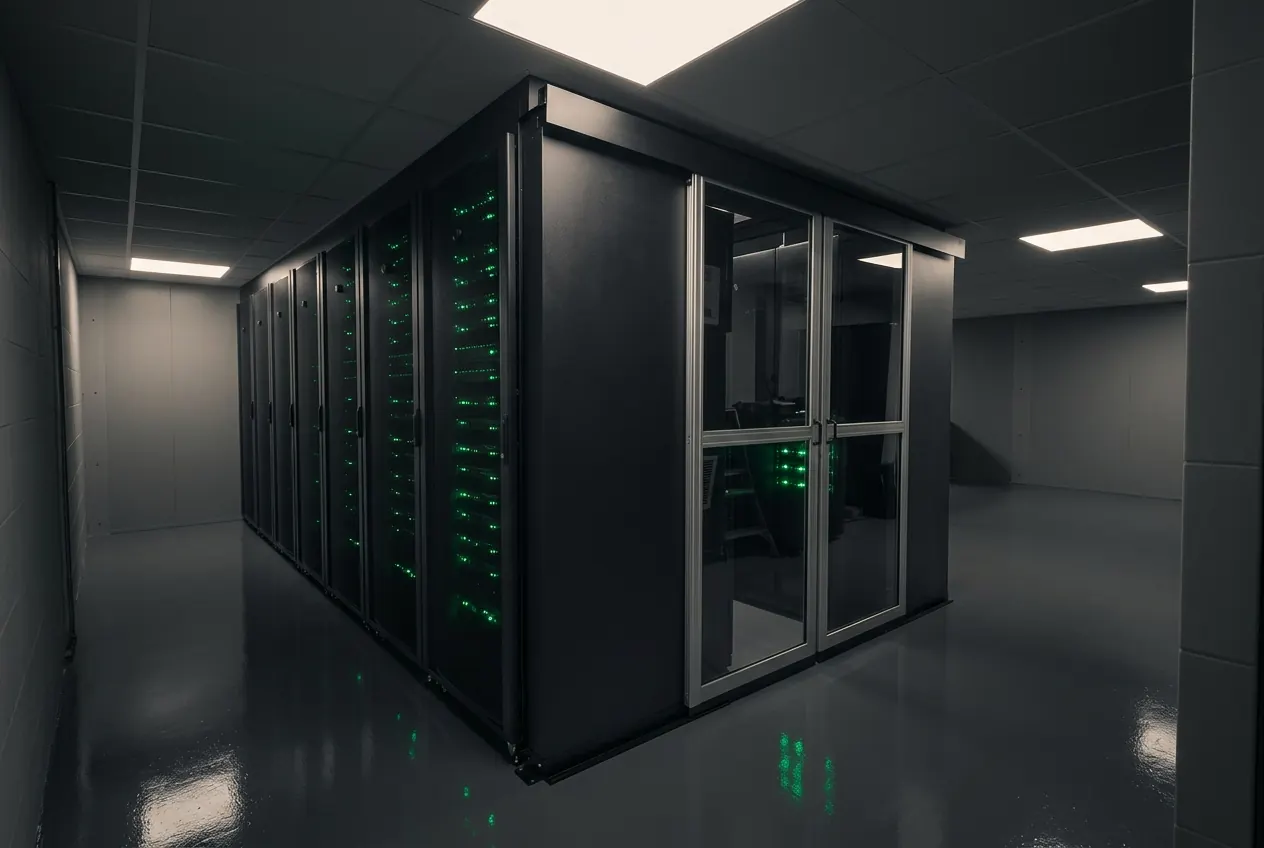
Cooling is where data centres quietly fail. ASHRAE A1 specifies a 18–27°C inlet temperature envelope; anything outside that and you'll see throttling, reduced hardware life, and a steady increase in disk and RAM error rates.
N+N cooling (two parallel CRAC paths each sized for full load) combined with hot or cold-aisle containment is the modern standard. Containment stops hot exhaust mixing with cold supply, which is what lets a Tier III facility maintain ASHRAE-compliant inlets at 8kW+ per cabinet without dumping cold air everywhere.
Network, peering and connectivity
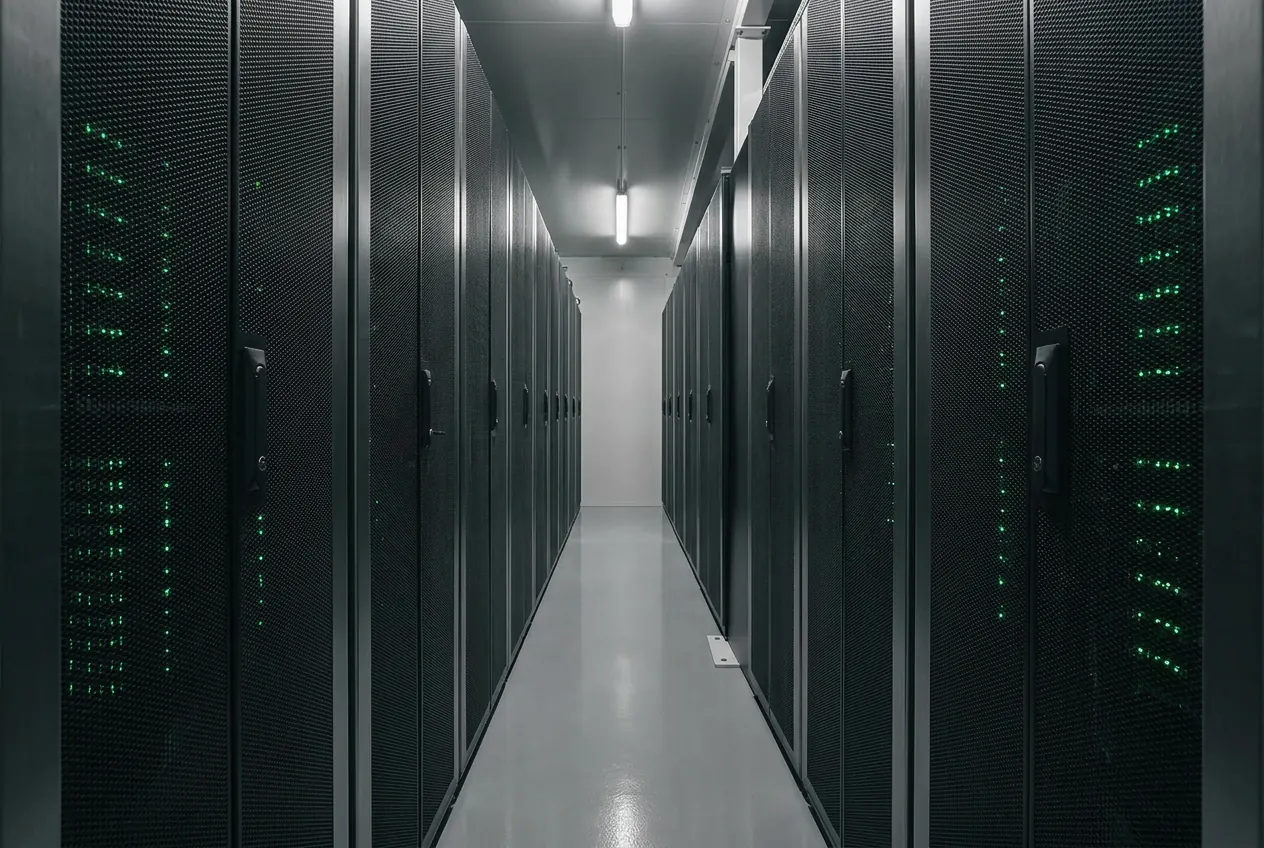
The network is what makes colocation feel like cloud. A serious UK colocation provider runs an owned BGP MPLS backbone, holds its own AS number, and peers directly at the largest UK internet exchanges — LINX (London Internet Exchange) and LONAP.
Why peering matters:
- Latency. Direct peering removes transit hops to UK eyeball networks (BT, Sky, Virgin, Vodafone, EE) and to AWS, Azure and Google Cloud edge nodes.
- Resilience. Diverse transit providers + multiple exchange fabrics means a single carrier failure doesn't take you offline.
- Performance for end users. A UK-hosted site served over LINX-peered routes typically lands in 5–15ms round-trip to UK consumers.
Fast2Host operates AS48825, peering at both LINX and LONAP with diverse fibre paths into Cambridge. Dedicated internet access, point-to-point lease lines and public cloud connect are all available as cross-connects from your rack.
Physical security
Tier III standards expect mantraps, anti-tailgating turnstiles, biometric access at the hall door, full CCTV with extended retention and 24/7 manned security. Look for ISO 27001 certification — it's the auditable proof that processes match the marketing.
For sectors with stricter compliance (finance, health, public sector), ask about PCI DSS attestation, Cyber Essentials Plus and documented change-control procedures.
Sizing your colocation footprint
Right-sizing is the difference between a tidy bill and a runaway one. As a rough rule:
- 1U–4U single-server. Great for a primary application server, a low-traffic web app or a development environment. Typically 100–400W draw.
- Quarter rack (10U). Two or three production servers plus a switch and KVM. Around 1–2kW.
- Half rack (21U). Production cluster plus storage. 2–4kW.
- Full rack (42U). A complete environment — app, database, storage, switching. 4–8kW for general compute, 15kW+ for dense workloads.
Don't oversize at day one — Fast2Host lets you start at quarter rack and grow into a full cabinet (or multiple cabinets) without migrating hardware.
SLA, remote hands and support
A real SLA names a number and pays out service credits when it's missed. Fast2Host offers 99.99% uptime on power and network, with credits applied automatically against your invoice.
Remote hands — the on-site engineers who can swap a disk, reseat a cable or rack new kit when you can't be there — is the other half of a workable colocation. Ask:
- Is remote hands 24/7, or just business hours?
- How is it billed — per-incident, per-15-minutes, or included?
- What's the response target for a P1 ticket?
- Are the engineers in-house, or third-party?
Why Cambridge?
Cambridge sits on the A14/M11 spine with diverse fibre routes south to LINX in Telehouse Docklands and west to Slough's data-centre cluster. It's outside the London power-density bottleneck, with cleaner power costs and lower thermal load — without sacrificing peering reach.
For UK businesses that need genuine UK data sovereignty, fast routes to London for trading or media workloads, and the ability to physically visit the facility, Cambridge is one of the strongest options in the country.
UK colocation buyer's checklist
Use this as a scorecard when you're shortlisting providers.
- Tier III concurrently maintainable design (or better)
- True A+B power on independent UPS strings + standby generator
- N+N or N+1 cooling with hot/cold-aisle containment
- Carrier-neutral network with peering at LINX and LONAP
- DDoS protection included as standard, not as an upsell
- ISO 27001 and ISO 9001 certified, with documented change control
- 24/7 manned security, biometric access, full CCTV retention
- Clear SLA with credits — not best-effort wording
- Remote hands available 24/7, with a published response target
- UK-staffed support — engineers, not gatekeepers
Frequently asked questions
What is colocation and how is it different from cloud hosting?
Colocation means you own the physical server and rent rack space, power, cooling and connectivity from a data centre. Cloud hosting rents virtual capacity on shared hardware. Colocation gives you full control of hardware, lower long-run cost at scale, predictable performance and no noisy-neighbour effects — but you're responsible for the kit.
What does Tier III mean in practice?
Tier III (Uptime Institute) requires concurrently maintainable infrastructure — every power and cooling component can be taken offline for maintenance without dropping live load. That requires N+1 capacity, dual power paths (A+B), redundant cooling and 99.982% expected availability.
How important is LINX and LONAP peering?
LINX and LONAP are the two largest UK internet exchanges. Direct peering shortens the path to most UK eyeball networks (BT, Sky, Virgin Media, Vodafone) and cloud providers, which lowers latency, removes transit hops and improves resilience against single-carrier outages.
How much power do I need per rack?
Most general-purpose 42U racks land between 4kW and 8kW. Dense compute (GPU, HCI, blade) can push 15–25kW and needs specific cooling planning. We provision dual A+B feeds — typically 16A or 32A per feed — and you only pay for what you draw.
Do I need to buy a full rack to colocate?
No. Fast2Host offers 1U/2U/4U single-server colocation, quarter rack (10U), half rack (21U) and full 42U cabinets — so you can right-size the spend and grow into more space later without migrating.
Can I visit the Cambridge facility?
Yes — colocation customers get 24/7 escorted access, and we welcome pre-sales site tours. Just contact the team to book a visit.
What's included with Fast2Host colocation?
Dual A+B PDU power, IPv4 and IPv6 allocation, 1Gbps or 10Gbps uplink, 600Gbps Corero SmartWall DDoS protection, free remote hands during business hours, 24/7 UK NOC monitoring and a 99.99% uptime SLA backed by service credits.
Talk to a Cambridge colocation engineer
Send us your power draw, U requirement and bandwidth profile and we'll come back with a priced, right-sized colocation proposal — no sales pressure, no minimum term lock-in.