
PHP2Shell: We Patched Every Server Before the News Broke
CVE-2026-109618 and CVE-2026-109619 are unauthenticated remote code execution in PHP itself. We applied the update across our servers in the hour before the 21 October advisory.
On 21 October 2026, PHP published fixes for two critical bugs in the language itself. Tracked as CVE-2026-109618 and CVE-2026-109619, and talked about as PHP2Shell, they can let an unauthenticated request run code as the web server user. The fault is in PHP, not in a plugin or a theme.
PHP’s advisory is plain about the remedy. PHP 8.5.12, 8.4.27, 8.3.36 and 8.2.35 fix both issues. There is no configuration change that makes an unpatched install safe.
We applied that update across our hosting servers in the hour before the advisory went public at 14:00 UTC. We have found no compromised sites on the hosting we operate.
1. What actually broke
PHP’s notice covers installations that serve web requests: PHP-FPM, Apache with mod_php, php-cgi, FrankenPHP and LiteSpeed. The project says the risk is highest for mod_php, where a request can trigger the bug before the application runs a line of its own code.
The two CVEs are memory-safety bugs. One is an out-of-memory path that can leave request data only partly initialised. The other can leave internal state behind after its memory has been freed, so a later request on the same worker reuses it. Wiz, which reported the issues, says versions going back to PHP 5.4 are affected by at least one of them, and that the same class of bug can read process memory as well as run code. PHP’s own score for the issue, as reported with the advisory, is 9.2. Early rumours of a perfect 10 were wrong.
Wiz also says PHP powers about 70% of websites, which is why a bug in the engine is not a niche CMS problem. WordPress, Drupal and Joomla were the applications used to demonstrate it. A site does not have to be one of those three to be exposed. A current application on an old PHP build is enough.
2. The bug was private for two months. The exploit was not, on the last day.
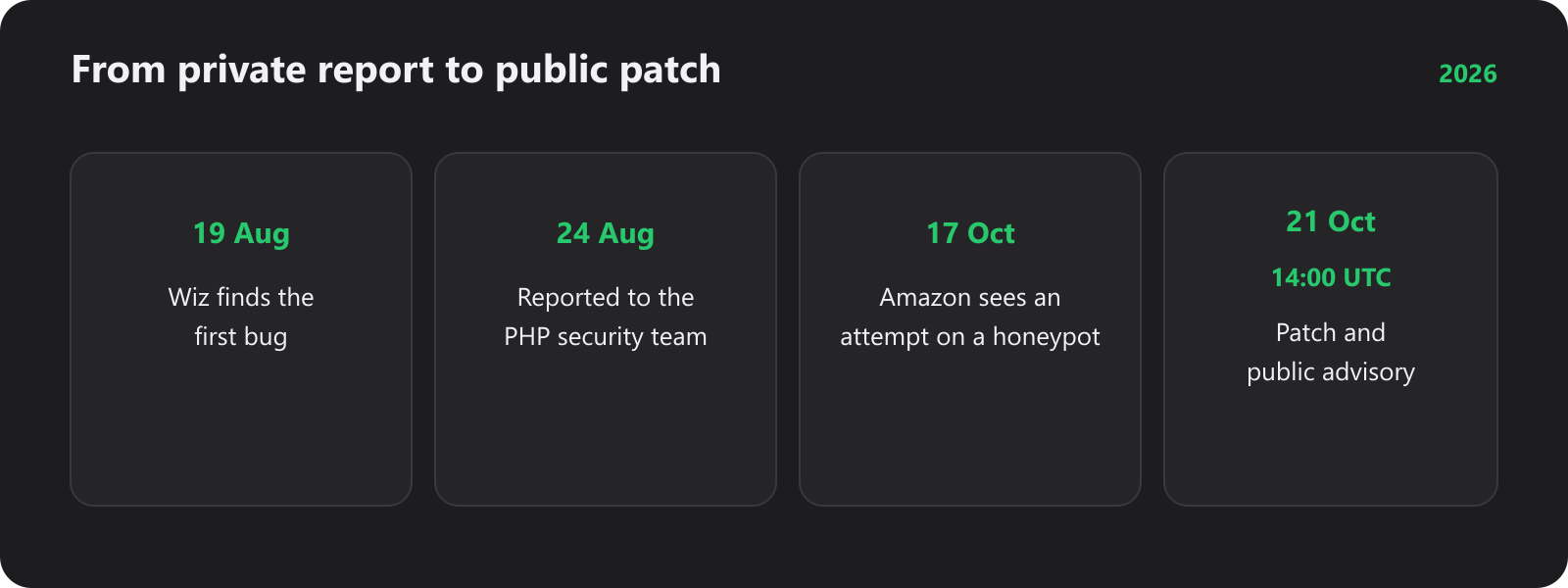
Dates from Wiz’s disclosure timeline and Amazon Threat Intelligence. The 14:00 UTC mark is when PHP lifted the embargo.
Wiz found the first bug on 19 August 2026 and reported it to the PHP security team on 24 August. PHP acknowledged the reports on 21 September and shipped the coordinated fix on 21 October.
That embargo did not hold until the clock ran out. Amazon’s MadPot honeypots recorded an exploitation attempt on 17 October, four days before the public advisory, from an address on a commercial anonymisation network. On 21 October, proof-of-concept exploits were circulating from about 02:00 UTC, twelve hours before the 14:00 UTC release. Amazon says it is not clear those early attempts would have worked on real systems. It is clear the public advisory was not the first moment anyone tried.
Once the patch was out, attempts widened the same day. A week later, Wiz’s follow-up said it had still not seen a successful end-to-end attack in its own customer telemetry, while other honeypots had. “Not us” is not the same statement as “nobody”. The useful reading is the one Amazon published with the timeline: for an internet-facing critical bug, the patch window is measured in hours.
3. What the first week of patching looked like
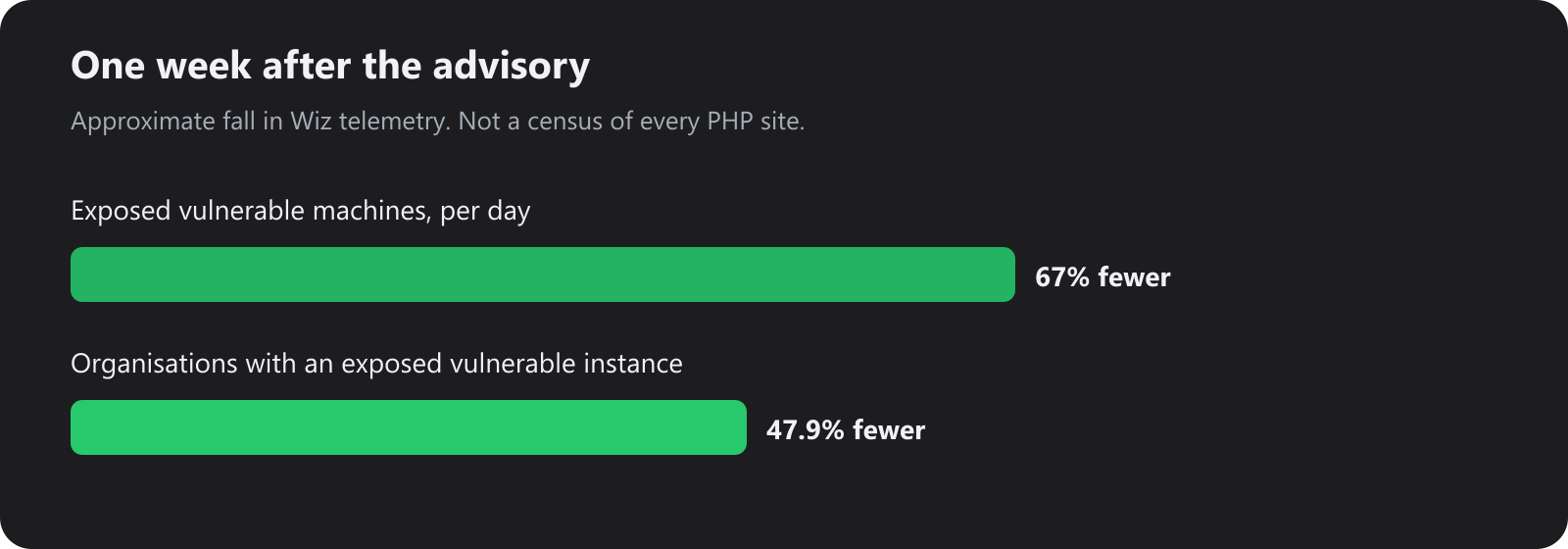
Approximate figures from Wiz telemetry in the week after 21 October 2026. “Less than 53%” of the organisations that were affected at disclosure were still vulnerable a week later. Scan coverage can move these numbers. They are not a count of every PHP site on the internet.
The same note splits out older PHP. Official packages from the PHP project covered 8.2, 8.3, 8.4 and 8.5. PHP 8.1 and older are outside the project’s own support, apart from minimal source backports for 7.4, 8.0 and 8.1. Among machines Wiz still classed as vulnerable, the share running PHP 7.3 or earlier dropped from 8.3% to 5.7% over five days. Those old builds were a minority of the vulnerable set. They were not gone.
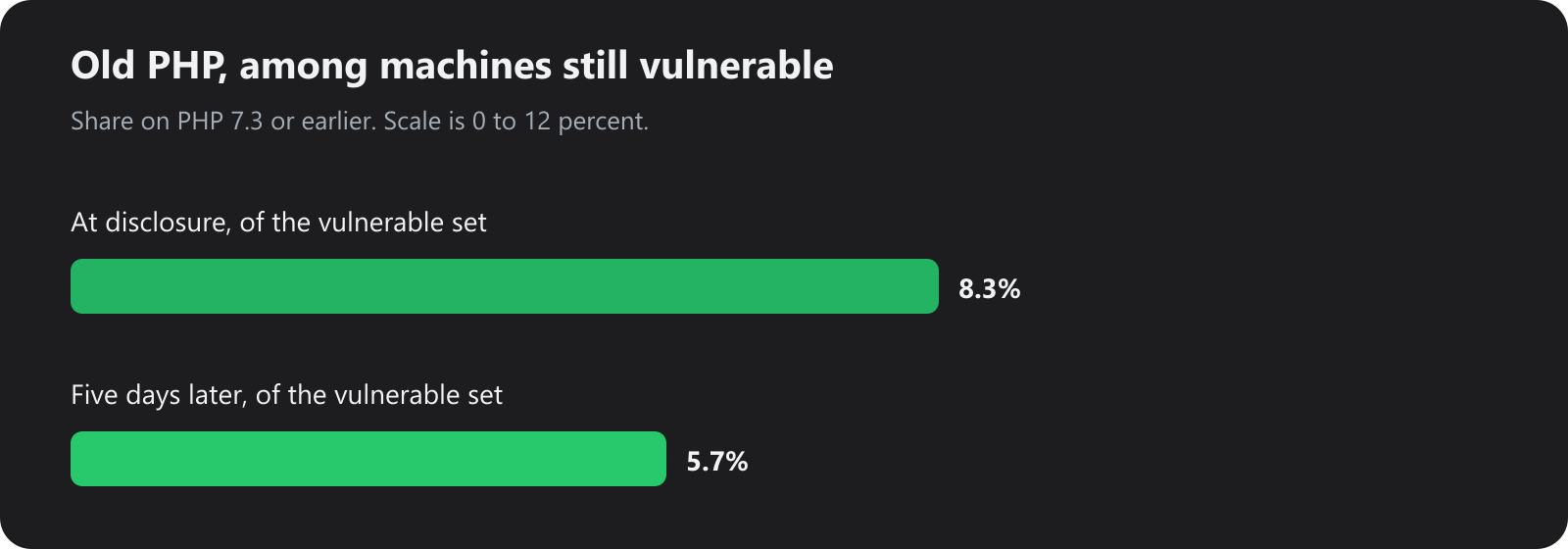
This is a share of the machines that were still vulnerable, not a share of all PHP. Source: Wiz, 27 October 2026.
4. What we did
Linux distributors and long-term-support vendors received the fix before the public posts. On our platform the job was to get those packages onto the servers that actually answer customer requests, and to do it before the write-ups landed.
That update was finished across our hosting servers in the hour before 14:00 UTC on 21 October. After it, we had no compromised websites to clean up. Patching is what made that true. It was not luck, and it is not a promise that a future bug will be this quiet.
If you run PHP somewhere else, on a VPS you manage or a server in colocation, the same advisory applies to you. Check the PHP version the site is really using, not the one you remember selecting last year.
5. Old PHP on cPanel, and what Windows Plesk will let you pick
The two panels do not offer the same list.
On cPanel hosting, CloudLinux is what lets a site stay on an older PHP selector. Our cPanel and reseller plans offer PHP 7.0 through 8.4 per site. Those older branches do not get new releases from php.net. They stay available because CloudLinux ships maintained builds, and the PHP project has said distributors can backport a fix when the upstream branch is finished. The 21 October update was applied to the selectors we offer, including those older ones. Leaving a site on PHP 7.4 is still a choice on cPanel. Leaving it on an unpatched build is not.
On Windows Plesk, the selector only lists PHP versions that panel still supports. You cannot pick an abandoned branch and hope a vendor package is hiding underneath it. After this release, a supported choice is one of the fixed branches: 8.2.35, 8.3.36, 8.4.27 or 8.5.12, or a later release in that line. PHP 8.2 itself reaches end of life on 31 December 2026, so a site that can move to 8.3 or newer should do that before the next issue, not after it.
If a Windows site is stuck because an old application refuses a current PHP, tell us before you look for an unsupported binary. Unsupported PHP on Plesk is not a selector we turn on for this class of bug.
6. What to check if the site is not on our shared hosting
- Read the version from the server, not from memory.
8.2.34is the vulnerable release immediately before this fix.8.2.35is the fixed one. The same pattern holds for 8.3.36, 8.4.27 and 8.5.12. - Treat “we will patch this week” as late. Amazon’s point was that attempts were already underway before the blog posts.
- Do not treat a php.ini tweak as a substitute. PHP says only the update closes both bugs.
- If the site is on our cPanel, WordPress or Plesk hosting, the platform update was ours to apply. If PHP runs on a VPS or dedicated server you administer, the package update is yours, and support can do it with you.
The engine was the thing that was vulnerable. The sites on our hosting were patched before the advisory was public, and none of them were compromised by it.
Fast2Host - UK Hosting. Real Infrastructure. Real Engineers.
Sources
- PHP security advisory, 21 October 2026
- GHSA-w8hw-w9fx-j79w, CVE-2026-109618
- GHSA-6wmf-4rv5-p3rp, CVE-2026-109619
- Wiz: PHP2Shell disclosure
- Wiz: exploitation and remediation, 27 October 2026
- Amazon Threat Intelligence on pre-disclosure attempts
This is an account of a platform update and of public reporting. It is not a guarantee about any server we do not operate, and it does not describe how to attack PHP.