
Why UK Businesses Are Rethinking Where Their Data Is Hosted
Data residency, security, performance and control: why the location of your business data matters more than ever.
For many years, businesses have focused primarily on the performance, cost and convenience of their hosting infrastructure. Whether a website runs on a shared server, a virtual private server (VPS) or a large cloud platform, the underlying assumption has often been that data can be stored almost anywhere in the world.
But things are changing.
As businesses become increasingly dependent on digital services, concerns about data security, privacy, regulatory obligations, international data transfers and infrastructure resilience are becoming much more important.
UK organisations are taking a closer look at where their data is physically stored, who has access to it, which laws and jurisdictions may apply, and what happens if something goes wrong.
For some businesses, this means reconsidering whether hosting their infrastructure within the United Kingdom is the right decision.
So why does hosting location matter, and what should businesses consider when choosing a hosting provider?
The latest official figures show why the question is no longer theoretical. The Department for Science, Innovation and Technology surveyed 4,450 UK businesses between October 2025 and January 2026 for the UK Business Data Survey 2026.
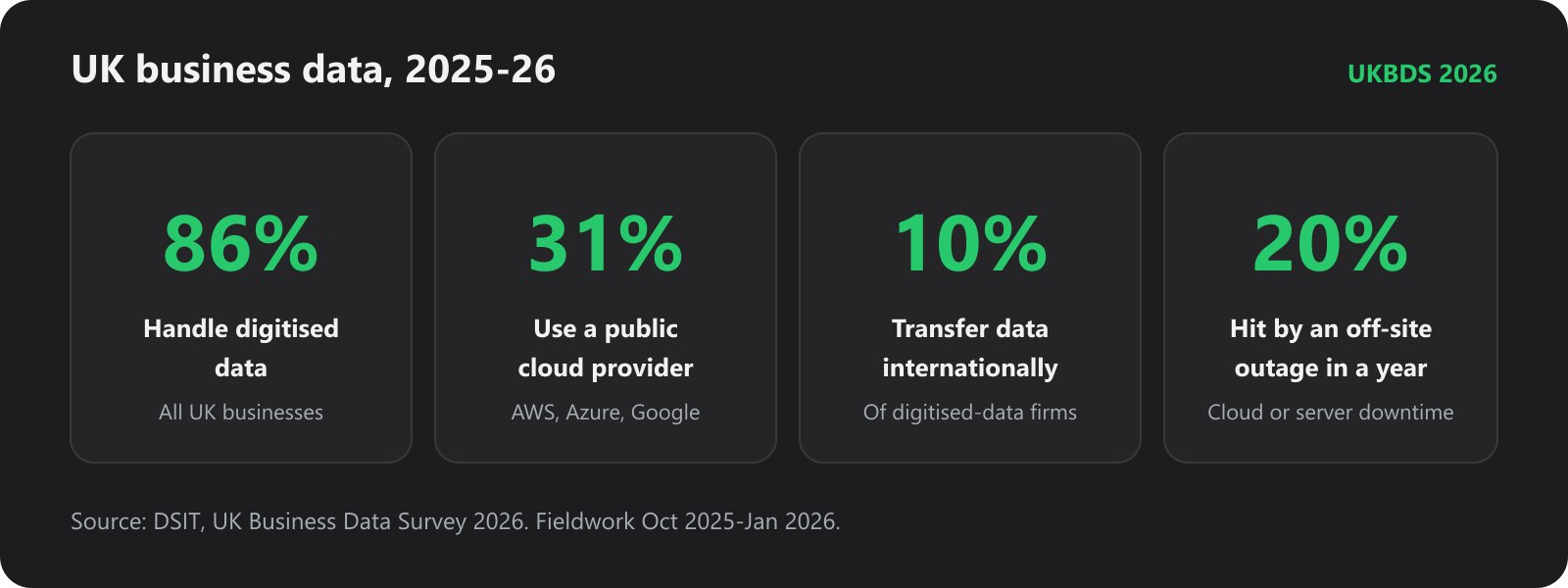
Source: DSIT, UK Business Data Survey 2026. The 10% figure is among businesses that handle digitised data (8% of all UK businesses). The 20% outage figure is among businesses that store data away from their own premises.
1. Data sovereignty and why it matters
One of the biggest reasons businesses are reconsidering their hosting arrangements is data sovereignty.
Put simply, data sovereignty concerns the laws and regulations that apply to information based on where it is stored, processed and accessed, as well as the organisations that control it.
When a business stores information overseas, it may introduce additional legal, contractual and operational considerations.
For example, a UK company using an overseas cloud provider needs to understand:
- Where its data is physically stored.
- Which countries the provider operates in.
- Which organisations or third parties can access the information.
- Where backups and disaster recovery copies are located.
- Whether overseas support teams can access customer information.
- What contractual arrangements govern international data transfers.
These questions are particularly important for organisations handling customer records, financial information, employee details or commercially sensitive business data.
Hosting within the UK can make it easier to establish where infrastructure is located and which parties are responsible for operating it.
It can also simplify certain aspects of supplier management and data governance.
UK-based hosting does not automatically make a business GDPR compliant. Organisations must still consider their wider data protection responsibilities, access controls, processing arrangements and security procedures.
2. UK GDPR and international data transfers
Data protection is another major consideration.
The UK General Data Protection Regulation (UK GDPR) and Data Protection Act 2018 establish requirements for organisations processing personal information.
One area that businesses need to understand is international data transfers.
When personal information is transferred, or made accessible, to a separate organisation outside the UK, additional rules may apply.
Depending on the destination and circumstances, businesses may need to rely on UK adequacy regulations, appropriate safeguards such as the International Data Transfer Agreement (IDTA), or a specific legal exception.
How common those transfers are depends on the size of the business. Among businesses that handle digitised data, 10% transferred data internationally in 2025-26. Large businesses were more than twice as likely to do so as sole traders.
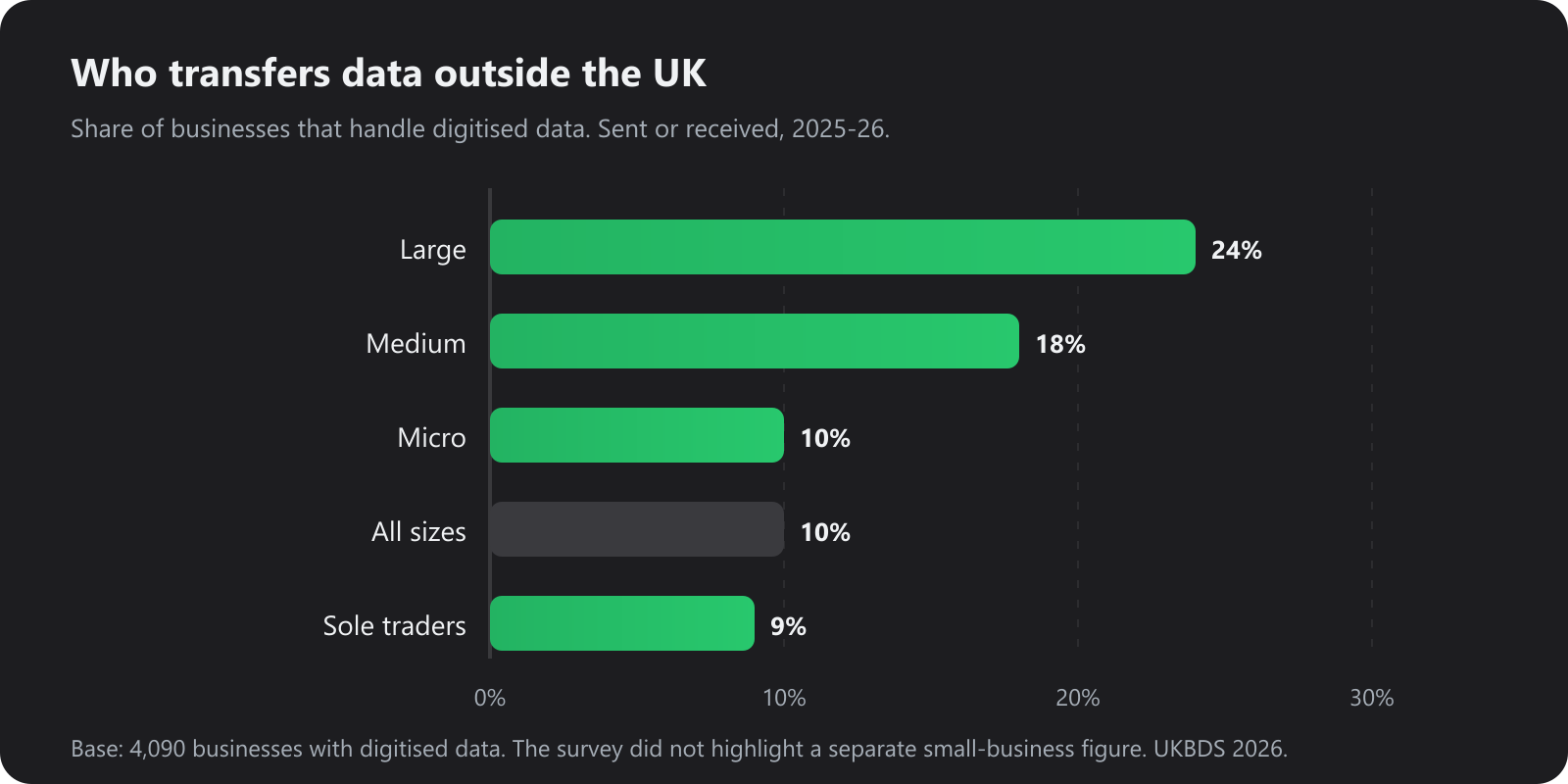
Source: UK Business Data Survey 2026. Base: 4,090 businesses that handle digitised data. The published results highlight large, medium, micro and sole-trader figures; they do not give a separate small-business percentage in the narrative.
Where those transfers go also matters. Of businesses that do transfer data internationally, 76% exchange it with the EU or EEA and 55% with North America. Regions overlap, because one business can name more than one destination.
| Region | Share |
|---|---|
| EU or EEA | 76% |
| North America | 55% |
| Asia-Pacific | 40% |
| Europe outside the EU and EEA | 36% |
| Middle East | 24% |
| Latin America and the Caribbean | 19% |
| Sub-Saharan Africa | 16% |
| North Africa | 14% |
Among businesses that sent personal data outside the UK, the safeguard picture is thinner than the confidence figures suggest. 47% said they used none of the mechanisms the survey listed.
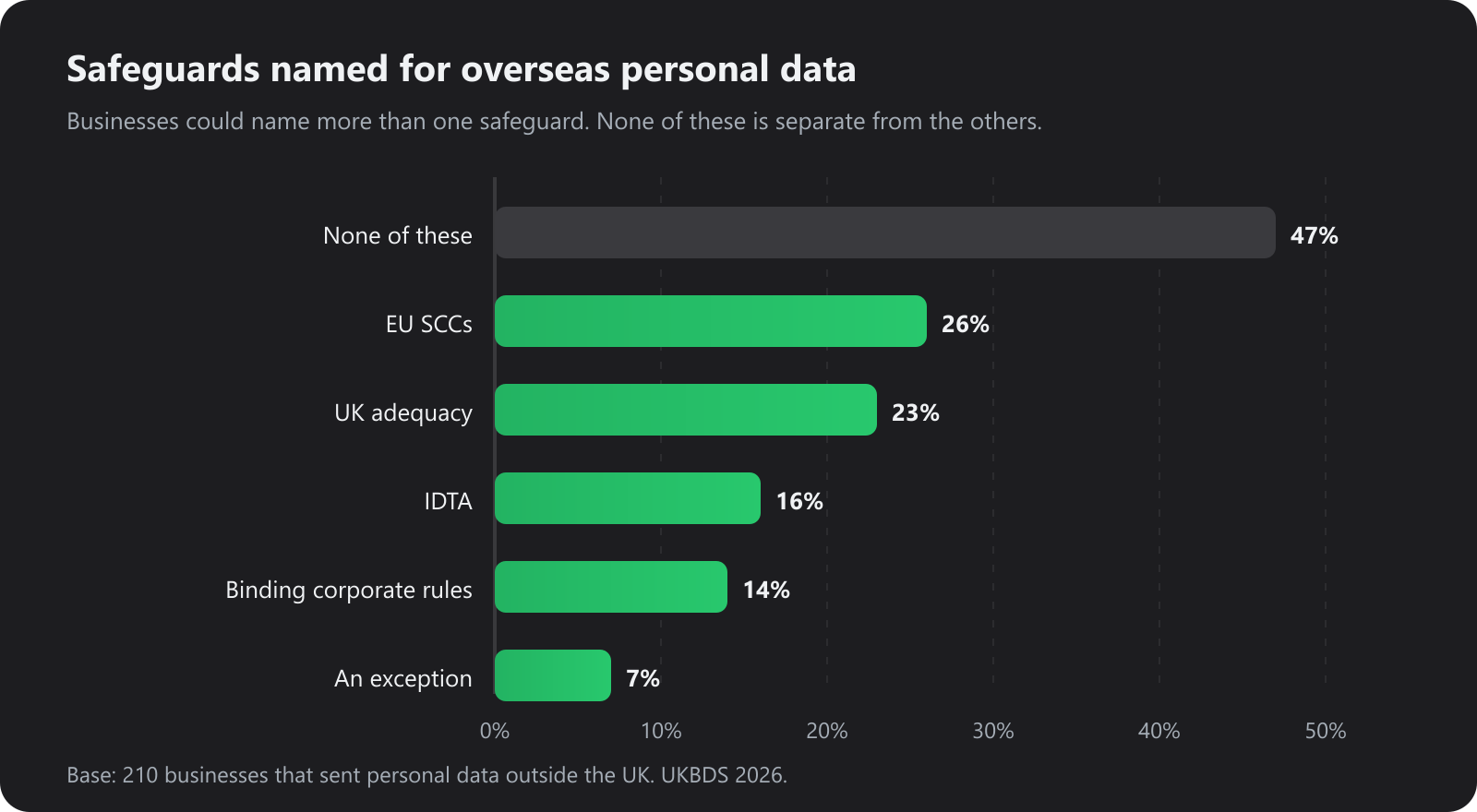
Source: UK Business Data Survey 2026. Base: 210 businesses that sent personal data outside the UK. Apart from “none of these”, businesses could name more than one mechanism.
This can introduce additional work for organisations responsible for managing personal information.
Businesses may need to review:
- Data processing agreements.
- International transfer arrangements.
- Supplier security practices.
- Transfer risk assessments.
- Data access and retention policies.
- The location of backup and disaster recovery systems.
Choosing a UK hosting provider can help reduce some of the complexity associated with overseas infrastructure, particularly where the hosting environment, operational support and data storage all remain within the UK.
It is still important to check the complete service arrangement rather than simply relying on the location advertised by a hosting provider.
For more information, the Information Commissioner’s Office (ICO) provides guidance on international data transfers.
3. Greater control over where business data is stored
Not all hosting providers operate their own infrastructure.
Some companies lease space from larger data centre operators, while others resell services from third-party cloud platforms.
There is nothing inherently wrong with these arrangements. Large cloud platforms offer extensive capabilities, scalability and global infrastructure. What the survey shows is that UK businesses already use several of them at once.
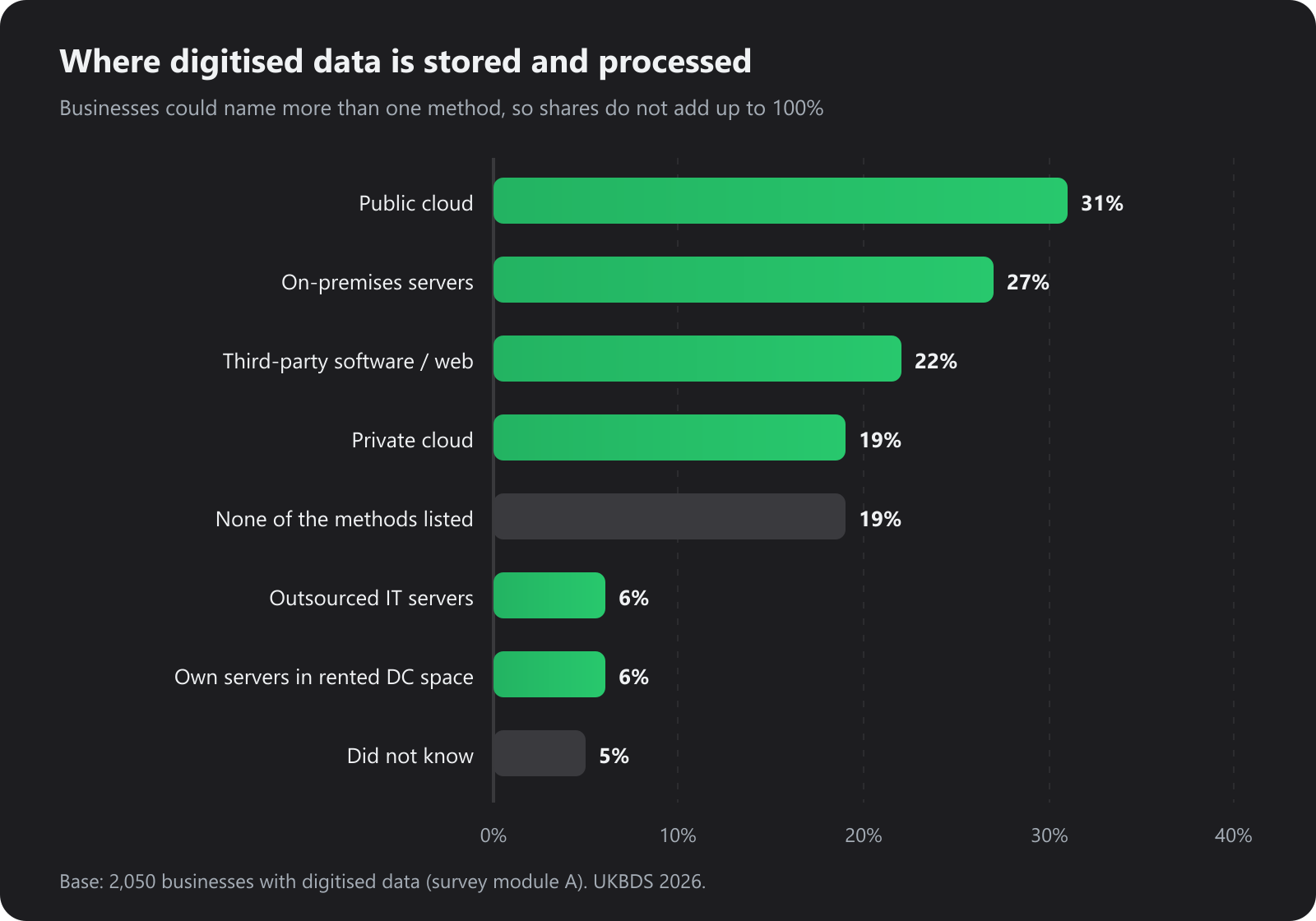
Source: UK Business Data Survey 2026. Base: 2,050 businesses with digitised data, asked in one survey module. Respondents could choose more than one method.
Large businesses were more likely to use a public cloud provider (60%) and to place their own servers in rented data-centre space (23%) than sole traders (30% and 5%). Only 6% of businesses overall said they keep company-owned servers in a rented data centre.
The useful distinction is between purchasing a hosting service and knowing who actually operates the underlying infrastructure. Questions worth asking include:
- Does the hosting provider own and operate its data centre?
- Can the provider confirm the physical location of your servers?
- Where are backup copies stored?
- Who is responsible for physical security?
- Are engineers employed directly by the provider or supplied by another company?
- Can you arrange access to the facility if required?
For organisations with specific security, compliance or operational requirements, greater visibility of the underlying infrastructure can be valuable.
This is one reason why privately operated UK data centres remain an important option for businesses looking for greater control over their hosting environment.
4. Performance, latency and keeping data closer to your customers
Data location is not just about regulation and security. It can also affect performance.
Latency is the time it takes for data to travel between two points across a network.
The further information has to travel, the more opportunities there are for additional network delay. However, physical distance is only one factor: routing, network quality, congestion and connectivity also play important roles.
For UK businesses serving predominantly UK customers, hosting infrastructure within the United Kingdom can provide a practical performance advantage.
This can be particularly relevant for:
- E-commerce websites.
- Business applications.
- Customer management systems.
- Financial and accounting platforms.
- Online databases.
- Hosted applications and remote desktop services.
- Websites handling frequent database requests.
A well-connected UK data centre with high-quality network infrastructure can provide excellent connectivity to UK internet service providers and international networks.
This is why choosing a hosting provider should involve more than simply looking at the geographical location of its servers.
The quality of the underlying network is equally important.
5. Security and infrastructure resilience
Location does not remove downtime. 59% of businesses that handle digitised data store at least some of it away from their own premises. Of those, 20% said a server or cloud outage affected them in the previous 12 months. Large businesses reported that far more often.
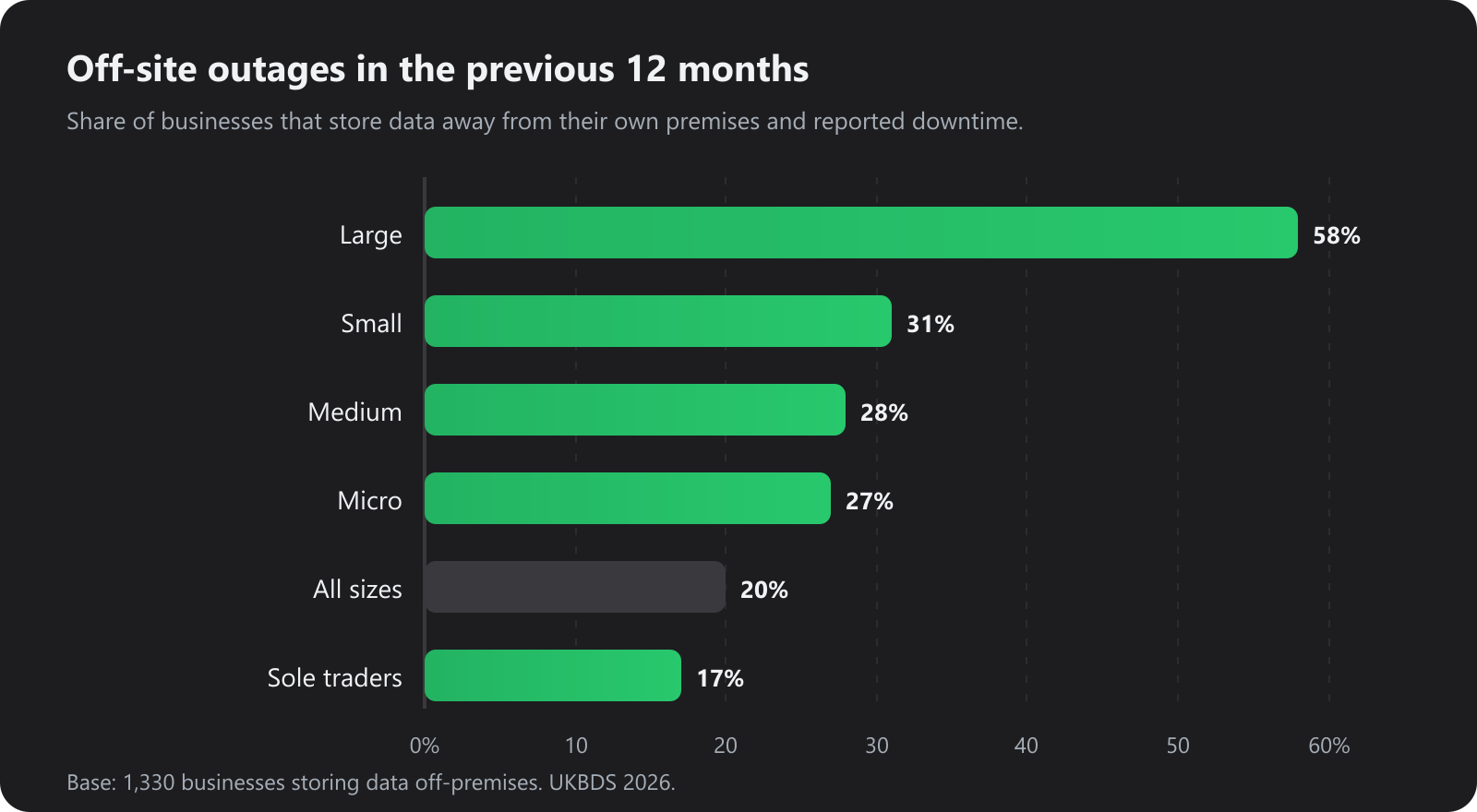
Source: UK Business Data Survey 2026. Base: 1,330 businesses that store data away from their premises.
Where your data is hosted is only one part of the security picture.
The physical infrastructure supporting your servers also matters.
Professional data centres are designed with multiple layers of protection to help maintain service availability and protect equipment.
These can include:
Physical security
Controlled access, CCTV monitoring, security systems and restricted access to server areas help protect equipment from unauthorised access.
Power resilience
Uninterruptible power supplies (UPS), redundant power distribution and backup generators help maintain operations during electrical interruptions.
Cooling infrastructure
Precision cooling systems maintain suitable operating temperatures and help protect servers from overheating.
Network protection
Redundant network connections, traffic monitoring, firewalls and distributed denial-of-service (DDoS) protection help defend services against network disruption.
24/7 monitoring
Continuous monitoring allows engineering teams to identify infrastructure problems and respond to incidents.
Businesses should ask potential hosting providers how these systems are implemented and what service-level agreements are in place.
A server located in the UK is not necessarily secure simply because of its location. The quality of the facility and the people operating it are what really matter.
6. Understanding the importance of data centre ownership
An increasingly important consideration is who actually owns and operates the data centre.
Many hosting providers rely on infrastructure operated by third parties. This can work perfectly well, but it introduces another organisation into the service relationship.
A provider that owns and operates its own data centre has more direct involvement in the infrastructure supporting its customers.
This can offer advantages such as:
- Greater visibility of the physical environment.
- Direct engineering involvement.
- More control over infrastructure changes.
- Direct responsibility for power and cooling systems.
- Better coordination between hosting, networking and physical infrastructure teams.
It can also make it easier for customers to understand where their equipment is located and who is responsible for maintaining it.
For businesses that require dedicated hardware, private infrastructure or greater control over their hosting environment, colocation is another option worth considering.
Rather than renting a virtual server, colocation allows businesses to install their own physical servers within a professionally operated data centre.
This provides control over the hardware while benefiting from the facility’s power, cooling, connectivity and physical security infrastructure.
7. Why UK-based engineering support matters
Infrastructure is only as good as the people responsible for maintaining it.
When a server develops a hardware fault, a network connection becomes unstable or a critical application stops responding, access to knowledgeable technical support can make a significant difference.
Businesses should consider:
- Where the support team is based.
- Whether technical support is available 24/7.
- Whether engineers have direct access to the physical infrastructure.
- How hardware failures are handled.
- Whether remote hands services are available.
- How quickly incidents are escalated.
A UK-based hosting provider with engineers operating the underlying infrastructure can offer a more direct support relationship.
For businesses running critical applications, this can be just as important as the technical specifications of the server itself.
8. What should businesses look for when choosing a UK hosting provider?
Choosing a hosting provider should involve more than comparing monthly prices or advertised server specifications.
Before committing to a hosting arrangement, a clear answer on each of these is worth more than a longer feature list.
| Topic | What a clear answer includes |
|---|---|
| Data location | Where the primary copy lives, where backups live, and which third parties can access either |
| Infrastructure | Whether the provider owns the building, and how power, cooling and physical access work |
| Network | Whether it runs its own network, which exchanges it uses, and whether DDoS protection is included |
| Support | 24/7 cover, where the engineers are based, and whether they can reach the hardware |
| Compliance | Certifications, a data processing agreement, written SLAs, and a list of subcontractors |
Consider the following:
Data location
- Can the provider confirm where your primary data is stored?
- Where are backups and disaster recovery systems located?
- Are any third parties involved in processing or accessing your data?
Infrastructure
- Does the provider own or lease its data centre?
- What power redundancy is available?
- How is cooling managed?
- What physical security measures are implemented?
Network
- Does the provider operate its own network?
- Which internet exchanges and upstream carriers does it use?
- Is DDoS protection included?
- What network uptime guarantees are offered?
Support
- Is technical support available around the clock?
- Are engineers based in the UK?
- Can the provider access your physical hardware when required?
Compliance and transparency
- Can the provider supply relevant certifications and security documentation?
- Are data processing agreements available?
- Are service-level agreements clearly documented?
- Can the provider explain its subcontractors and data handling arrangements?
A reputable hosting provider should be able to answer these questions clearly.
9. Why Fast2Host operates its own UK data centre
At Fast2Host, we believe that knowing where your infrastructure lives and who operates it should be straightforward.
We own and operate our privately run data centre just outside Cambridge, providing UK businesses with access to professional hosting and colocation infrastructure.
Unlike providers that simply resell space within another operator’s facility, we have direct involvement in the infrastructure supporting our customers.
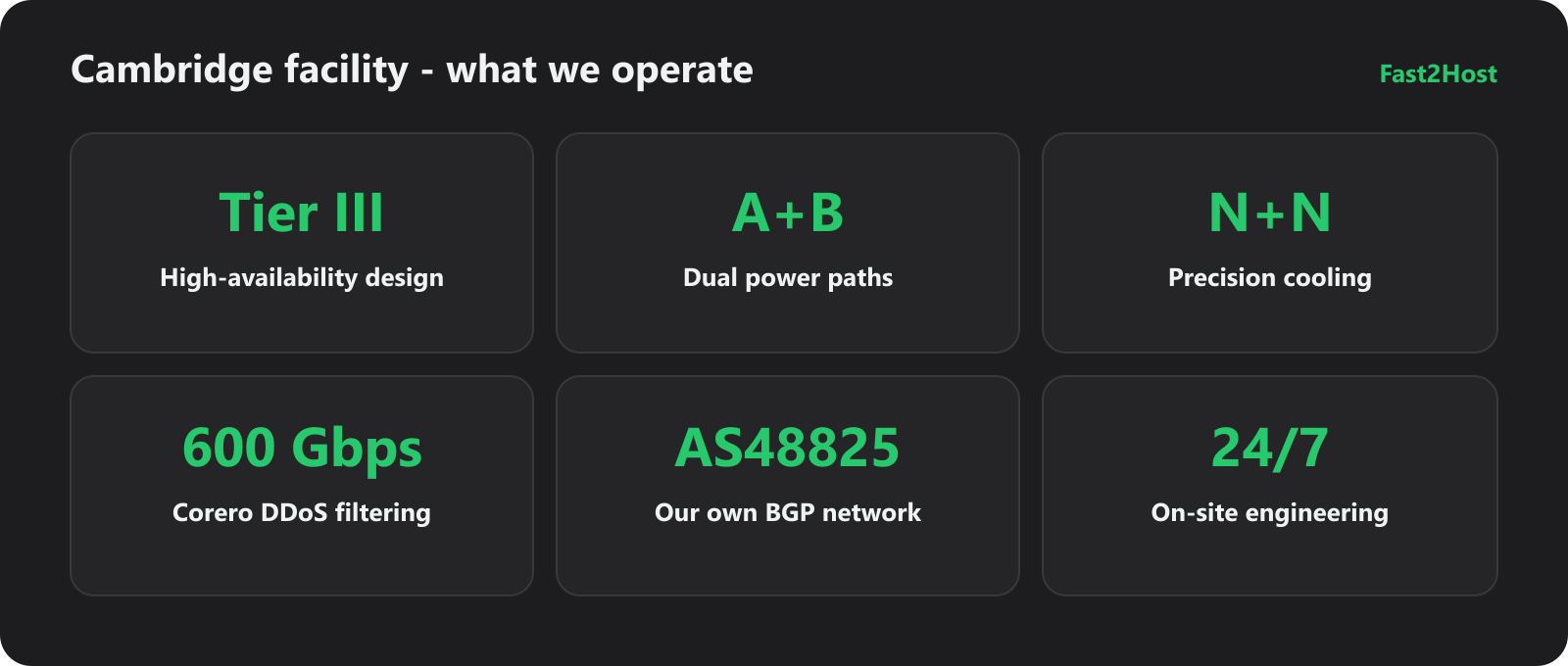
Cambridge facility operated by Fast2Host. Network detail is on the network page; DDoS filtering is covered under DDoS protection.
Our Cambridge facility includes:
- High-availability Tier III facility design.
- Redundant UPS power infrastructure.
- Dual A+B power distribution.
- On-site standby generator.
- N+N precision cooling.
- Controlled physical access and CCTV monitoring.
- 24/7 on-site engineering and monitoring.
- Carrier-independent network infrastructure.
- Connectivity through LINX and LONAP.
- 600Gbps Corero SmartWall DDoS filtering.
We also operate our own BGP network, AS48825, giving us direct control over important aspects of network routing and connectivity.
For customers, this means dealing with a provider that is directly involved in operating the data centre, network and hosting infrastructure.
Whether you need a dedicated server, VPS hosting or colocation for your own hardware, we can help you choose an environment suited to your requirements.
You can find out more about our facility on the Cambridge data centre page.
Or explore our UK colocation services.
10. Is it time to rethink where your business data is hosted?
The decision about where to host business data should never be based on price alone.
Data protection, operational resilience, network performance, infrastructure ownership and technical support all deserve consideration.
For some organisations, a global cloud platform will remain the right choice. For others, keeping critical infrastructure within the UK can offer greater visibility, more control and a hosting environment that better matches their operational requirements.
The important thing is to understand exactly where your data resides, who can access it and what infrastructure supports it.
As businesses become increasingly reliant on digital services, these questions are only going to become more important.
Looking for reliable UK hosting backed by real infrastructure?
At Fast2Host, we operate our own Cambridge data centre and UK network, providing dedicated servers, VPS hosting and colocation services supported by our UK engineering team.
Get in touch with us to discuss your requirements.
Fast2Host — UK Hosting. Real Infrastructure. Real Engineers.
- Website: fast2host.com
- Telephone: 01480 260 000
- Email: sales@fast2host.com
Further reading and useful resources
- ICO – A brief guide to international data transfers
- GOV.UK – UK Business Data Survey 2026
- Fast2Host – Cambridge Data Centre
- Why hosting in Cambridge still matters
This article is intended for general information and should not be treated as legal or regulatory advice. Businesses should assess their own data protection and international transfer obligations.